Friday, February 5, 2010

Some Signage on Clark

6404 N. Clark

This old sign now hangs above a taqueria, which I think is a good symbol for the demographics of my neighborhood.  I'm pretty sure you can't get chili or hamburgers there.  Why don't they take it down?  First of all, it's massive.  It's probably been attached directly to the structure of the buildling.  Those little chains you can see just keep it from swaying in the wind.  Also, I'm not sure zoning will allow a sign like this anymore.  It projects maybe six feet into the public right-of-way.  The owner may have decided that they can repair and reface it more easily than apply for a new sign.  Unfortunately, most of the old neon has cracked off.

6701 N. Clark

This storefront used to be Dennis' Place for Games, a video arcade. Now it's a liquor and convenience store.  I can't say I'm a big fan of the internally illuminated cabinet sign, but the amount of lighting on this one approachs theater marquee status. 

We have an amazingly open weekend. Felix has his swim class at the YMCA on Saturday, but as far as I know there are no other commitments.  That's a very nice feeling after the last few weekends. Maybe we'll go to the Shedd Aquarium, or something. 

Thursday, February 4, 2010

Dearborn Street Bridge

Built: 1963
Stephen Michuda, engineer

Dearborn has the distinction of being the location of the first moveable bridge in Chicago, built in 1834.  This bridge is the fourth incarnation and it's faced with polished granite with stainless steel mullions.  In 1963 this received an award of merit by the American Institute of Steel Construction.  Maybe for using plenty of steel?  You can see the edge of Marina City to the right, which was being constructed at about the same time.
Today is the meeting of the Permit Review Committee of the Commission on Chicago Landmarks.  For this first time in months I have no projects to present.  This means next month I'll have half a dozen, so I'm trying to appreciate the moment.

Wednesday, February 3, 2010

Larry's New Blog

This entry marks the beginning of my new blog. Mainly it consists of drawings, a little bit of history, and brief personal updates. Most of these were posted to my old MySpace blog, so there are some odd formatting changes between the two. Sometimes you may need to click on a graphic to see it at the appropriate size. Anyway, I thought this would be a good non-intrusive way to keep friends and family updated about what’s going on with me, Angela and Felix and share some of the projects I've been working on.

Ultra Local Geography refers to the infrequent publication I put together to explore under-appreciated architectural features in my neighborhood. Although occasionally I branch out into the rest of Chicago.  Sometimes I contribute illustrations to locally produced newspapers or magazines, and most of these will get a test run here first.

Friday, December 18, 2009

Michigan Avenue Bridge, detail

Built: 1920
Edward Bennet, architect
Thomas G. Pihlfedlt, engineer
Hugh Young, engineer

This is the northeast bridge house of the Michigan Avenue Bridge, completed in 1920. This bridge basically opened up the north side of the river for development, which eventually transformed from quiet Pine Street to the Magnificent Mile.

All four bridge houses have high relief sculptures incorporated into the structure. This one is called "The Discoverers" and shows LaSalle, Marquette and Joliet being guided by an armored angel carrying the torch of knowledge. Or something like that. First-rate propaganda.

Monday, December 14, 2009

Jackson Boulevard Bridge


Built: 1916
Thomas Pihlfeldt, engineer
Alexander VonBabo, engineer

This bridge was built by the Sanitary District. Does it look sanitary? It's very much like the other octagonal bridge houses but this one is cast concrete rather than stone or terra cotta. Maybe not the best choice, since it looks like it's falling apart.

Thursday, December 10, 2009

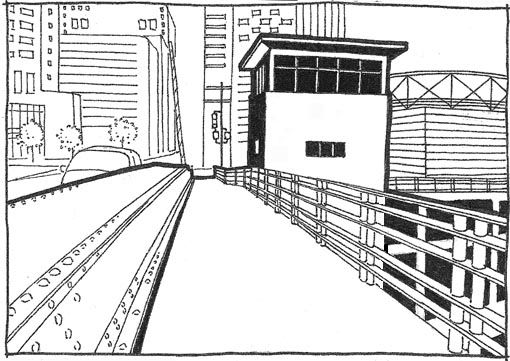
Van Buren Street Bridge

Built: 1956
Stephen Michuda, engineer

This bridgehouse looks like a guard tower for a prison. Maybe that's what they were going for. Also, I've seen these same railings on bridges spanning the Sanitary Ship Canal on the north side. They must have been standard IDOT design in the 50s. To the right you can see the support structures for upper and lower Wacker Drive.

Monday, December 7, 2009

Adams Street Bridge

Built: 1927
Thomas Pihlfeldt, engineer
Donald Becker, engineer
Clarence Rowe, engineer

For some reason this bridge is always covered with pigeons... I left them out for clarity.  This time.  The design is influenced by Parisian models.  It's similar to the LaSalle bridge houses, but less elaborate.

The information I've found is good about naming engineers that worked on the project, but less useful at identifying the origination of the bridge house designs.  Some were apparently designed by Edward Bennet (of the 1909 Plan of Chicago fame) and some follow his design specifications.  But I need to track down some better documentation for the more unusal designs.

Monday, November 30, 2009

Monroe Street Bridge

Built: 1919
Thomas Pihlfeldt, engineer
Clarence Rowe, engineer
Hugh E. Young, engineer

This bridge was one of three paid for by Union Station in exchange for approval of the Union Terminal Ordinance of 1914. Quid pro quo. Behind and to the left is the “old” Chicago Mercantile Exchange Building (1987). The 40,000 sq.ft. trading floor has now been cut up for new offices.  The design closely adheres to the City Beautiful principles- high quality materials with a decidedly classical bent. It's easy to think of these bridge houses as tiny monuments.

Saturday, November 21, 2009

Dearborn Street Bridge, detail

Sometimes to really appreciate a bridge you've got to get underneath it. Swimming in the Chicago River is not recommended, but I do recommend the water taxis. For a mere $2 you can hop on a boat at Madison and take it to Navy Pier, Michigan Avenue, or Chinatown. You might pay $25 for an architectural river tour, but for far less you can sit next to a crazy local who mumbles angrily about politics and points out the failures of the new Trump Tower.

Friday, November 13, 2009

Franklin-Orleans Bridge

Built: 1920
Thomas Pihlfeldt, engineer
Clarence Rowe, engineer
Hugh Young, engineer

This bridge is just east of the confluence of the 3 branches of the Chicago River, known as Wolf Point. Back in the 1830s this was the place to be, where you could find taverns, hotels and more taverns. Nowadays it looks kind of crummy. The Sun Times building is in the background, which is one of the more aggressively awful looking buildings in Chicago.  Completion of this bridge was delayed in part by WWI.

Monday, November 9, 2009

Clark Street Bridge

Built: 1929
Paul Schioler, engineer

This is a view looking south across the river towards the Loop. In the background to the right you can see a half-built hotel which has basically been abandoned since the developer went bankrupt. Strange thing to see in the center of Chicago.

If anyone cares, all the bridges around the loop are double-leaf Bascule bridges. It's fun to say that fast.

Wednesday, November 4, 2009

Madison Street Bridge

Built: 1923
Thomas Pihlfeldt, engineer
Clarence Rowe, engineer
(rehabbed, 1994)

This may be the busiest bridge downtown, since both Union Station and Ogilvie Station let out onto Madison west of the Chicago River. The bridge houses are almost identical to Wells but the real difference is the bridge structure. What it loses in drama it makes up in unobstructed views to the north and south.

You wouldn't think the narrow sidewalks would accommodate a guy drumming on big plastic buckets every day during rush hour, but you'd be wrong.

Thursday, October 1, 2009

LaSalle Street Bridge

Built: 1928
Edward Bennet, architect (confirmed?)
Donald Becker, engineer
Thomas Pihlfeldt, engineer
Clarence Rowe, engineer

This 1928 bridge coincides with the extension of Wacker Drive on the south.  Only two of the bridge houses are (or were) functional.  The other two were just for symmetry. The decorative mansard roofs are lead.

I like including the background buildings for these drawings. Its going to be tricky to keep them from attracting too much attention. This view is to the west, looking slightly northwest towards Merchandise Mart.

Monday, August 3, 2009

Lake Street Bridge

Built: 1916
John Ericcson, engineer
Thomas Pihlfeldt, engineer
Alexander Vonbabo, engineer

I'm very fond of the bridges that also accommodate the el. I didn't want to draw too much attention to it, but I was lucky to have it go past when I was taking reference photos. This drawing is a good reminder of why I seldom choose a format larger than 4 inches. It's too easy to get caught in the tiny gradations of cross-hatched tone. One more bridge at this scale, and the next three will smaller, more simplified. If I need more detail I can always include some close-ups.

On Saturday we leave for our vacation. This will be the first week-long vacation since before Felix was born. We're renting a house on Kelley's Island for a week. For anyone unfamiliar that's in Lake Erie near Sandusky. Nothing to do but swim, read, walk, and draw. And possibly go to restaurants featuring super-sweet Ohio wines. Our house even has a fire pit, which sounds like mixed blessing when combined with a three-year old. My brother-in-law and sister-in-law will be joining us. Even my parents will drop by for a night. This is kind of a new experiment for us, so we'll see how it goes.

Monday, June 29, 2009

Washington Street Bridge

Built: 1930
Edward Bennet, architect
Thomas Pihlfeldt, engineer
Alexander VonBabo, engineer

Bridge house originally clad with copper sheet metal, but there looks to be alot of odd repairs.

This is looking east towards the Loop across the Chicago River. You can see the edge of the Civic Opera on the right. I had this idea to create drawings of every bridge around the Loop and to compile them into a booklet with a little history for each one. Would tourists buy that sort of thing? Could I sell them downtown without getting arrested? Probably not.

Drawing every bridge seemed a lot more achievable before I found that this one took me two weeks of lunch breaks.

Wednesday we leave for another whirlwind trip to Ohio. Felix can see the grandparents and we can forget about work for a while. I hope. Turns out the union rejected the City's offer for furloughs instead of layoffs. As of July 15th 1,500 city workers will be gone. It seems like random luck that I'm not included. This time.

Tuesday, May 5, 2009

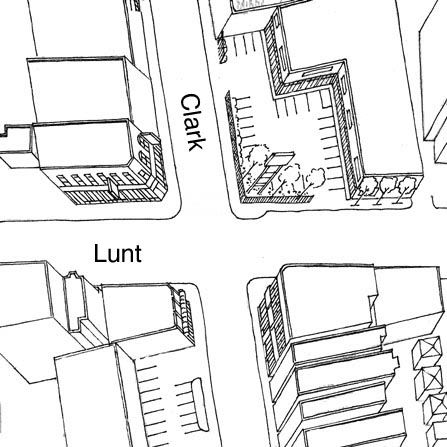
Clark and Lunt- Bird's Eye View

OK, not a true bird's-eye view, since it combines two paraline drawings. But a good way to add additional months to the project. To be honest, I can't imagine doing this for twenty-five more intersections.

So we spent a long weekend in North Carolina about 3 weeks ago. Angela was invited to teach an improv workshop, and Felix and I tagged along. It was like getting an amazing spring preview. We spent alot of time with our friends Dan and Lee, and explored the Raleigh, Durham, Chapel Hill area, which is beautiful. Dan and Angela used to perform together, and it was his theater that had extended the offer for a workshop. Apparently it was a big hit.

I'm amazed at how quickly Felix adapts on these trips. After the first day he said, "I like our new car." We tried to explain that it was a rental. Once we returned to Chicago he kept asking if we were going back to the hotel. As long as we're all together he's home.

Tuesday, March 24, 2009

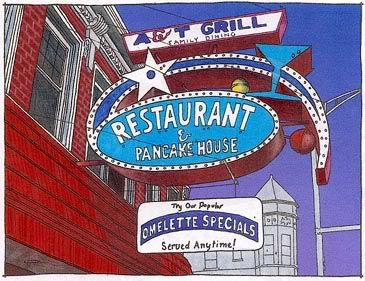
Clark and Greenleaf- A&T Grill Signage

OK, still putting together some color graphics for signage on Clark. For anyone who's interested, here's the most recent process:

-Develop outline from reference photograph. In this case I made two versions, one which eliminates the background elements to focus just on the sign.
-Scan both versions to print out at slightly larger size. Decide to use the more cluttered version.

-Develop grey marker tone study.
-Develop color drawing with Prismacolor markers.
-Scan into 300 dpi tiff. Adjust edges. Add graduated background tone.
-Print scan. Create highlights and details with Prismacolor pencils.
-Rescan. Adjust colors. Create reduced size version for blog.

Not sure it was worth the effort, but I want to give a copy to the owners of the A&T Grill. It might make them hesitate if they're considering removing the sign. It's already missing quite a bit of neon.

Saturday, March 14, 2009

Clark and Lunt- Currency Exchange

OK, another second tier financial service on Clark. We actually get our city stickers here. Also one of the few corners in Rogers Park where prostitutes are regularly arrested.

Tuesday, February 24, 2009

Money Transfers and Check Cashing on Clark

I had never seen these businesses before I moved to Chicago. Cash transfers are everywhere in Rogers Park. They're probably as common as the payday loan stores.

These businesses aren't regulated like banks, and they may charge rates that take advantage of workers who don't have many other options, like bank accounts or credit cards... 

Not sure anyone can fit more signage on this building.

Thursday, February 19, 2009

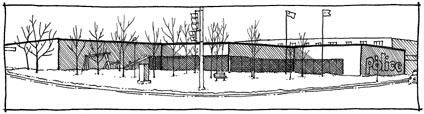
Clark and Schreiber, northwest corner

Do you remember the "literals" craze in the 1980s? Bags labeled "Brown Bag" and mugs labeled "Mug"? Did you know they did the same thing with buildings? The Rogers Park police station is living proof. In huge lowercase letters it reads, "police" on the wall nearest Clark. As if that could make up for the aggressively unattractive design. Maybe worse of all, it creates a huge windswept plaza along the most auto-dominated stretch of Clark. Optimistically there's a single bench. And what kind of trees were chosen for the plaza? Locust trees, whose most admirable quality is resistance to pollution.