Tuesday, July 18, 2006

Demolition of the Adelphi Theater

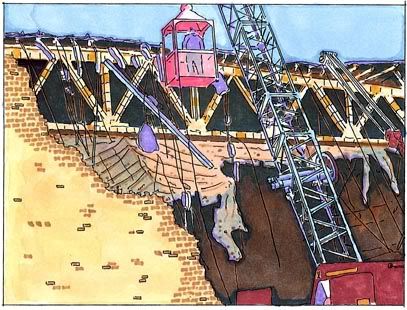
This is a view of the demolition of the Adelphi Theater at the southwest corner of Estes and Clark fom last February. Right now the site is an empty sandlot surrounded by plywood barriers.


Generally they'll start demolition at the back of the building. By the time the casual observer realizes it's coming down, it's already gone. There's a large condo building proposed for the site, but for some reason construction hasn't started. Maybe they lost their money.

In recent years the owners could never seem to make this theater work. It opened once as a venue for Indian movies. Then it briefly opened again as a discount theater. For the longest time the marquee promised "Grand Opening- Coming Soon!" That was a bit overly optimistic.

This original theater was no masterpiece, but there's a long tradition of theater conversions in Chicago, from The Howard to The Century. Not always seamlessly done, but a decent way to maintain the identity of the street. I just hope the Alderman didn't trade a character defining building for a vacant lot.  Not that the Alderman could have stopped the demolition of a privately owned building, but he could have made it more difficult.

Wednesday, July 12, 2006

Our Neighborhood Shrine

Did you know that there's a shrine to the Virgin of Guadalupe on Rogers Avenue, one block west of Clark? In 2001 people recognized the Virgin's outline on the tree trunk, about 8 feet up. I only found out about this later, and by the time I walked past I couldn't figure out where to look, or what shape to identify. Don't the outlines of all the saints look the same? Maybe if I had someone to point it out to me I would be able to see it.


Anyway, the area is draped with plastic flowers and votive candles. It reminds me of those impromptu memorials people set up on the side of the road where a child is hit by a car. What's amazing is that its remained for 5 years. It probably drives the Streets Department crazy. And people are still bringing fresh plastic flowers and votive candles to it. Some generous soul even donated a few old office chairs. Its a good example of messy neighborhood vitality, although I wouldn't mind seeing some real flowers there on occasion. After all, this is a saint we're talking about.

Wednesday, June 21, 2006

Dragon on Ashland

I was out walking with Felix and spotted this cast stone dragon ornament on the entrance of a great apartment building on Ashland north of Pratt. There was another one on the opposite side of the entry, but it had even more electrical conduits running around it.


I had this idea for a Rogers Park booklet called, "Following Felix". I would walk through the neighborhood with Felix in his sling and take a photograph of everything that catches his attention. Ideally Felix should wear a helmet with a camera that snaps a photograph at regular intervals. Then I would work up line illustrations for as many as I could, and try to figure out what appeals to the eye of an 8 month old. There could be a huge market for this! Right? I imagine Felix would look alot like one of those Borg babies.

Friday, June 16, 2006

18th Street looking west


OK, here's the last Pilsen drawing that I'm going to post. When I first started to use a technical pen I
got a thrill out of creating intricate details and then completely covering them with cross-hatching. Somehow the eye perceives the detail even with the most minimal information.

A painter I admire used to talk about all of the meaning he would hide in the dark areas of his paintings. I don't think anyone knows exactly what he was hiding, but somehow you can feel it there.

When a drawing is reduced digitally you have a near total loss of detail. But if the image is a good one compositionally it may seem like something more is there. Keep in mind it may simply be a good reduction of a mediocre image.

Wednesday, June 7, 2006

19th Street and Blue Island


Here's another drawing from the Pilsen exhibit at Mess Hall. This is one of the few drawings I've done entirely from a photograph. I normally use reference photographs, but usually I take them myself from several angles and distances. When you only have one image to work from you have to do alot of interpretation. Everything has to look like it makes sense, even if you're not 100 percent sure how it all goes together. The goal is to have a unified image that can overcome all the ambiguities in lighting, materials, and construction. It's good to have goals.

Thursday, May 4, 2006

Aluminum Grill at the Monadnock Building


Whenever I'm walking south to Printer's Row I always make it a point to go through the first floor of the Monadnock Building. Its dim, ponderous hallway always brings me back to old, 1890s Chicago. At 16 stories it was briefly the world's tallest office buildng. But if you visit make sure to notice the cast aluminum ornamentation.


In the mid 1800s aluminum cost $545 per pound, which made it more valuable than gold or silver. In 1886 a scientist at Oberlin College (20 minutes from my hometown, Lorain, OH) discovered how to separate pure aluminum via electrolysis. By 1892 the cost had droped to 57 cents per pound. But I'm sure it still had a certain appeal to the architectural elite. So the Monadnock building was outfitted with aluminum newel posts, staircases, and grillwork. The drawing above is detail from the air return at the entrance off of Van Buren. Nice stuff.

Just as a note, someone recently sawed off one of those newel post caps from an upper floor. No one noticed. Or if they did notice, it didn't occur to them that anyone could do it without official sanction.

Monday, April 17, 2006

Currency exchange at Clark and Lunt


I'm not sure what it is about currency exchanges that seem quintessentially "Chicago" to me. Maybe because I never saw one until I moved here. Every service they offer can be found somewhere else (and more cheaply) but they conveniently bring everything right to the corner for a modest fee.

The first time I renewed my city sticker at a currency exchange I was surprised to have them fill out the forms right in front of me. What luxury! All I had to do was sign.

Of course if you don't have a bank account and depend on the currency exchanges to cash your paycheck and pay your bills its much less of an adventure. Those percentages add up. In my neighborhood a lot of people don't have a choice. It's a very profitable business, without much local regulation.

Friday, April 14, 2006

North Eastlake Terrace entrance detail


There are some great apartment buildings east of Sheridan Road right at the Evanston border. Some of them are perched on Lake Michigan, and need their own breakwaters. Amazingly, there's a tiny beach and park all on this same block.


I imagine the wind off the lake can be pretty bad in the winter, but it would be worth it to watch the sun come up over the water in summer. And best of all, most of these are rentals. Maybe this is one of the last tiny corners on the northside where anyone can have a million dollar view.

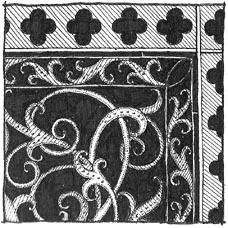
This detail is from a project that brought together all sorts of cast stone and terracotta door surrounds. It didn't make the final cut, but I like it enough to inflict it on the world.

Wednesday, April 12, 2006

The old apartment at 2015 W. Lunt


Ah, the old apartment. I lived there for 3 years, which is longer than any other place since I left for college in 1991. That gives you an idea of how transient I've been.

This was a great apartment. It had a circular plan. If we wanted, we could chase the cat for hours. Then the landlord paved over the tiny backyard along with our miniature garden patch. The building was sold, and the new owner replaced the picket fence with a solid stockade along the alley. I imagine that tiny backyard is a lot like a dark, concrete hole nowadays.

Summer evenings we used to sit back there drinking coffee and feeling very sophisticated.

Friday, April 7, 2006

It's a dolphin. Sort of.


Believe it or not, this weird terracotta ornament is supposed to be a dolphin. Maybe you've see Neptune astride similar critters? I can only guess that people didn't see dolphins too often in classical times, and developed an unpleasant caricature of a dolphin in place of the actual, svelte version. The creepy, scaled version then entered the lexicon of architectural ornament.


This is from an apartment building on west side of Sheridan Road north of Greenleaf.

Wednesday, March 29, 2006

Safety at Morse and Glenwood!


Rogers Park was recently blessed with a new device, courtesy of the Chicago Police Department. It's a video camera in a box at the northwest intersection of Glenwood and Morse. It has a blue strobe light and the police insignia, in case you were in danger of overlooking it. Glenwood and Morse have a reputation (not-unearned) of being a trouble-spot. But cameras can't see around corners.

  High-tech surveillance never makes me feel safer. I know that somewhere in an accounting department, someone is trying to figure out how many cameras equal one police officer.
  

Tuesday, March 21, 2006

W.J. Rutledge Residence, 1924


This French Eclectic style home lasted just over 75 years. The lot has an incredible lakefront view now being enjoyed by a new home. I haven't been over to see it yet, but I imagine it's a great place to park.
There was a historic district proposed for this neighborhood, but it didn't receive enough support to be adopted. Months after the demolition was approved I received a call from an architect who told me the new owners intended to renovate the structure completely, and update it to meet market demands. This sounded too good to be true, which it was.

Friday, March 17, 2006

Winthrop House, 1952


How can you not love this great ranch house? It's built like a squat little barn, complete with red
board and batten siding. The single car attached garage is brilliant. It was designed like a chicken coop with a ridge ventilator. It was built at a time when it shared the road with a number of real barns. Now even the fake rural structures are coming down. I expect this house to be demolished within a week.

Thursday, March 16, 2006

The Krumbach Building, 1922


This Art Deco terra cotta building is one of the few in the area that's survived Loyola encroachment. The frieze under the cornice shows the Chicago skyline from the 20s.

I started this drawing just before I went on paternity leave and finished it last week. No larger project in mind for this picture, but maybe I can use it for something down the line. Birthday present, maybe?


Thursday, March 9, 2006

I take pictures of teardowns

I work for a suburban government north of Chicago. One of my regular duties is researching residential teardowns to determine if they could potentially become landmarks. People seeking a teardown submit photographs, and I research permit records for the date of construction, owner, and architect. If it looks like a good house, I'll drive out and take my own photographs. As you can imagine, people who apply for teardown aren't too happy to think of their home becoming a landmark.


I've researched over 500 demolitions, and it's given me a peculiar relationship to the neighborhoods. I can drive down any street, see what's there, and remember what it replaced. As the teardowns accumulate, the memory of the street seems to fade. New construction attracts new construction and the pace quickens. At this point, a few streets are approaching 50 percent replacement.

Although we've lost a number of very historic houses, it's really the mediocre, everyday homes that define the character of the neighborhoods. Sure, we have our historic districts to preserve certain qualities, but I find myself more and more interested in the unremarkable home as a bearer of culture.


This isn't addressed very well in the current preservation literature. Landmarks and historic districts protect architectural and historical significance. But what protects insignificance? Nothing. Why would you protect it? It's only explored through geography, ethnography, and studies in material or popular culture. But those disciplines don't have the strong value stance you find in historic preservation. The demolition and replacement of insignificant structures provides just as much information as the preservation found in a historic district.


One solution is to expand the definition of "significant." You can already see this happening with the formation of tract housing historic districts. But to the credit of the preservation movement, the same old rules apply, especially in the face of newly significant styles. Even a ranch house can embody quality of design, integrity of materials, and importance in the larger context of the community.

But what about the ranch house covered in tar paper with colonial replacement windows and a two-story stucco addition? Who will speak for this? Not the historic preservation commission. Not the neighbors. Not the activists.

As my interests shift, I realize that there must be ways to help people recognize the significance of the insignificant. It can't be saved, because there's no aesthetic, historic, or economic reason to save it. But can I train the eyes of others to value it in the same way I do? Still working on ways to do this. It may not be a question of history or architecture, but a question of art and identity.