Showing posts with label marker. Show all posts

Wednesday, September 13, 2017

Every Lot Chicago


Recently I've been fascinated with the Every Lot Chicago Twitter feed.  This is basically just an algorithm that looks up tax ID numbers and pairs them with an image, typically from Google Street View.  New posts are generated about every 20 minutes. I find the randomness really interesting.   

These are monochromatic pen-and-marker studies of a few of my favorites. But the real challenge is not having favorites, but drawing them as they get posted!  I'm not really there just yet.

Thursday, January 2, 2014

Storefront at 6962 N. Clark, 2006

Many blogs post their most popular entries around the new year. Great idea! But instead, here's one of the least popular entries, originally posted on 9/5/06. According to the counter, this was viewed 11 times in the past 7 years! Still, I do like the image.
___________________________________________________________________________

With the days getting shorter my evening walks with Felix have gotten much darker. I find myself drawn to the strangely organized and uncomfortably configured storefronts on Clark. In this case I'm not sure exactly what they're selling. Pretty much everything? The confusion and disarray makes it a pretty good subject for a drawing.

So I've been taking photographs of these amazing storefronts. I'm not sure where it's leading, but it's a good opportunity to play around with color.  This is a combination of Prismacolor markers and color pencils.

___________________________________________
Note:  This storefront has been completely replaced with a modern aluminum system.  I miss it.

Thursday, August 15, 2013

Frame Houses on Estes, 1907


So I'm continuing to document some of the more common frame homes in an area of Rogers Park bounded by Touhy, Clark, Pratt and Ridge.  One of the best ways to do this is to spot a rows of homes clearly related in their massing, materials, characteristics, and then go draw them.


Gable front cottages are the classic workers' housing in Chicago.  You may have seen the gold-plated versions of these from the 1870s and 1880s in Old Town and Lincoln Park, where they've often been elaborately restored with eave brackets and complex window and door moldings. What you see above are simplified versions, with minimal ornamentation and generous front porches.  All four were permitted in 1907 for owner John M. Carlson.  The first two cost $2,500 each, but the next two cost only $2,000 each.  This is the advantage of building identical homes- each time you find ways to estimate the building materials more accurately and make the process more efficient.  And of course this translates into a greater profit.


Less than a block to the east there's another cluster of homes.  These were developed by Jacob Meirel, and four of the six were permitted in October of 1907.  Two alternating models were built.  The gable design provides for greater attic volume, while the hipped roof includes a front-facing dormer to introduce more light.  Both designs have partial-length front porches and projecting bays on the first floor.  These were built for $4,000 each, a substantial step-up from the basic cottages down the street, but still affordable to a middle-class household.

So there's nothing revolutionary going on here.  Developers are moving into a neighborhood and cautiously building a few homes.  If they sell and a profit is made they build a few more.  Variations in size and price occur to tailor the homes to different budgets, often on the same block.  This is the heyday for this type of frame construction in Rogers Park.  Lots which don't develop in this period will be developed later at a greater density due to the increases in the cost of land, labor, and materials. But for now let's enjoy Rogers Park in its suburban phase...

You can see previous postings about other frame houses in this area here and here.

Wednesday, April 20, 2011

Courtyard Apartments in Rogers Park- Parapet Details

If you want categorize the ornament on a courtyard building (and who doesn't?) look at the rear parapet at the back of the court.  A building may have a variety of bays and window treatments, but it's really the decorative parapets that give it character and establishes the stylistic theme and rhythm of the facade.  The parapet is outlined against the sky, which emphasizes each curve and castellation. In some cases a false gable or mansard roof is used in place of the masonry parapet, but the effect is similar.


7405-7415 N. Damen, 1927


The most common treatment is a face brick with stone sills, lintels, coping and medallions.  In the case above stone urns are used to emphasize corners and provide additional focal points. I'm a particular fan of cartouches and coats-of-arms, as if the builder raided some ancestral mansion.

6901-6917 N. Ashland, 1923


Here the castellated parapet is offset against glazed roof tiles, which provide additional texture and rhythm. When I see parapets like this I always imagine tiny people pouring tiny buckets of boiling oil down onto the mailman.
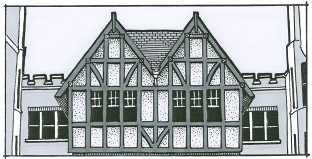
2100-2110 W. Fargo, 1927


The Tudor Revival style is regularly adapted for large courtyard buildings.  Sawn lengths of wood approximate the look of heavy timbers.  In this case, the interstices are covered with stucco, creating a variety of geometric shapes contrasting with the dark wood timbers.

1622-1630 W. Farwell, 1927


This is another parapet that takes its cues from the Classical Revival style, but also makes use of stones panels with inset pointed arches common to a more Gothic style.  It's not unusual to see these buildings mix and match their ornament, creating a unique fusion of eclectic styles. 

1519-1527 W. Farwell, 1929


This is a more simplified version of the Tudor Revival, with multi-colored slate shingles on a false mansard roof.  The half-timbering is fairly complex, including small quatrefoils.  In this case both stucco and brick were used as infill elements.  The slate shingles still gives these buildings a touch of class.

I have a few dozen more of these to document, but those above will have to serve as a representative sample for the moment.

Tuesday, February 16, 2010

Lorain Sketches

Two or three times a year we drive for 7 hours to visit my parents in my hometown, Lorain, Ohio. I was born in Lorain and lived there until I graduated from college.  I have a lot of fond memories of the place, but it's been a depressed town for decades.
When I'm visiting I'm drawn to buildings that look depressed.  I'm not sure why.  There are plenty of very nice, non-vacant buildings in Lorain.  OK, not an enormous amount of them, but enough. 

Colorado Avenue is a good street to spot vacant buildings.  Some look like they used to accomodate light industry and some look like retail stores fallen on hard times.
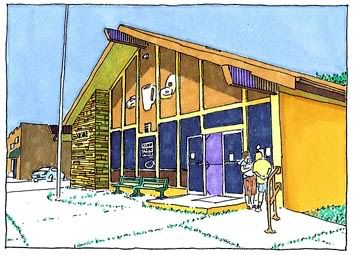
Above is the American Legion Post on West Erie Avenue.  This is a complex that's actually grown over the years.  But it doesn't exactly radiate a feeling of prosperity.
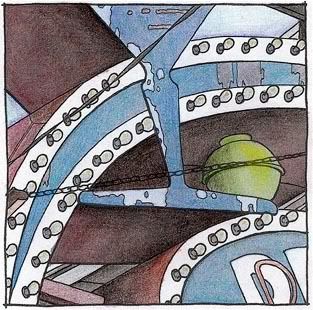
This is the old Dairy Queen on East Erie Avenue, now Terry's Dairy.  They didn't bother to remove the old Dairy Queen signage framework. I'm not sure if this is out of business or just closed down for winter.  It looks out of business. DQ used to represent the end-point of our longest family walks in the summer.
And of course, watching over the lakefront is the old Ohio Edison Plant.

I often wonder what my life would be like if I still lived in Lorain.  Someone once told me that no matter where you go you'll only have roots in the place where you were raised.  But can roots outweight a depressed economy and a struggling government?

But I have to admit, I've had a strange Lorain daydream lately.  I dreamed that everyone who left to pursue college degrees, or careers, or families suddenly decided to return.  All of the empty houses suddenly had buyers.  The hardware stores sold-out of ladders and paint.  The doctors and lawyers renovated the vacant storefronts downtown.  An influx of thousands of kids required schools to be repaired and reopened.  It could happen.  Or if it can't, why not?

Tuesday, March 24, 2009

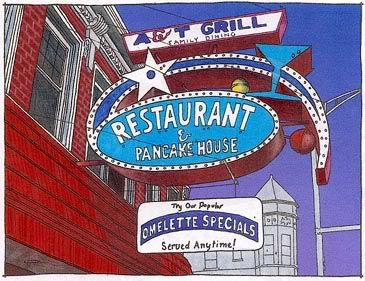
Clark and Greenleaf- A&T Grill Signage

OK, still putting together some color graphics for signage on Clark. For anyone who's interested, here's the most recent process:

-Develop outline from reference photograph. In this case I made two versions, one which eliminates the background elements to focus just on the sign.
-Scan both versions to print out at slightly larger size. Decide to use the more cluttered version.

-Develop grey marker tone study.
-Develop color drawing with Prismacolor markers.
-Scan into 300 dpi tiff. Adjust edges. Add graduated background tone.
-Print scan. Create highlights and details with Prismacolor pencils.
-Rescan. Adjust colors. Create reduced size version for blog.

Not sure it was worth the effort, but I want to give a copy to the owners of the A&T Grill. It might make them hesitate if they're considering removing the sign. It's already missing quite a bit of neon.

Tuesday, February 24, 2009

Money Transfers and Check Cashing on Clark

I had never seen these businesses before I moved to Chicago. Cash transfers are everywhere in Rogers Park. They're probably as common as the payday loan stores.

These businesses aren't regulated like banks, and they may charge rates that take advantage of workers who don't have many other options, like bank accounts or credit cards... 

Not sure anyone can fit more signage on this building.

Saturday, January 31, 2009

43rd and Cottage Grove

OK, I've ventured out of Rogers Park for this drawing. This is kind of on the edge of Bronzeville on the south side. Had it been a bit warmer it would've been a great area to explore better. There's a historic district (Oakland) near the east terminus of 43rd, and I was intent on making a site visit without a car. One advantage is that you can meander a bit on the way back to the El. This sign is still in front of a furniture store, although probably not the original tenant that put it up.
Thursday, January 10, 2008

And now in color...

Did I ever mention that these are eventually worked out in color? It's my cut-rate version of grisaille painting, with grey markers and colored pencil. The tone sketch is just to help me simplify things. I tried working entirely in colored marker last year, but it just made everything look so darn cheerful.

Our car is in the shop. After pouring money into it so we could get to Ohio safely (which we did) the steering went out entirely on Monday. And of course, steering isn't covered by the extended warranty.

I submitted a proposal to lead a tour downtown for the "Great Places and Spaces" festival, which offers hundreds of free tours of Chicago in May. I proposed "The LaSalle Street Canyon Tour," and invited Professor Euan to be co-tour guide. I'll look at things from the architectural standpoint, and he can talk about geography and social history. Who wouldn't enjoy that?

Sunday, December 30, 2007

Clark and Greenleaf, sign detail

I spent some of this morning snapping more photographs on Clark Street, this time focusing on details. Felix slept in his stroller. I like taking photographs while pushing a stroller. I'm obviously just another crazy on Clark.


I went back to Ohio last weekend for all of 24 hours. Angela stayed to visit with her Mom and brother, and I took a cheap flight from Hopkins to Midway. Wednesday Angela and Felix drove back with Anthony, and he visited with us for a couple days.

Tomorrow I'll be working, but I don't think it will be very busy. We might even be able to leave early...

Almost forgot! Angela ran a 5K race in the bitter cold. She said she saw a falcon catch a squirrel. Or a mouse. Or possibly a pigeon. I remain skeptical.

Monday, July 30, 2007

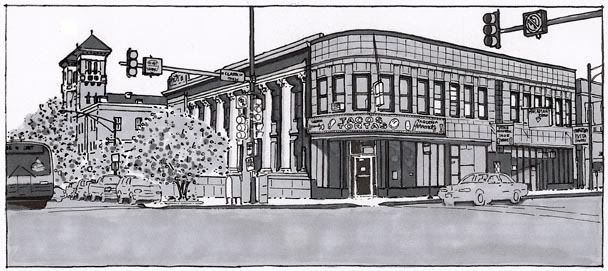
SE Corner of Lunt and Clark

Built: 1926
Converted and altered: 1944

I think I must have drawn this corner more than any other in Rogers Park. To me, it's the perfect representation of change in the neighborhood. On the Lunt side, it's still a limestone and granite bank, complete with columns. On the Clark side it's a terra cotta storefront from the 40s. In the background the bell towers of St. Jerome's watch over everything.  I've been looking for a photo of this building prior to the alterations, but all I've found is blurry microfilm scan in the Chicago Tribune archives.

We went to the Newberry Library book sale on Saturday. One of us would play with Felix in Washington Square Park while the other browsed the selection. The Bughouse Square Debates were going on too, but they're never as much fun as the book sale.

Oddly, there were about 5 or 6 people in the park painting with big portable easels. And most of them were painting trees. I would think that if you're painting in Chicago you could find something a bit more interesting than trees...

Monday, October 16, 2006

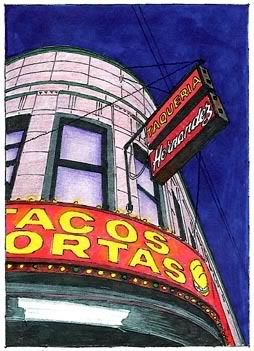
Taqueria Hernandez

This is a 1940s terracotta addition to an old bank at the southeast corner of Lunt and Clark. You can see all of the classical columns and granite base on the Lunt side of the building, but from Clark this is all you see. I imagine the stairs that led up to bank were ripped out to make way for this. I think there are apartments on the second floor, and I've always wondered if there are any interior remnants. Probably not.
When the article about Ultra Local Geography was published by the Chicago Tribune last June this building was visible in the photograph that accompanied the story. A woman called me up because she recognized the corner from her childhood. It was where her policeman father was shot and killed by a bank robber in 1945. It's easy to forget that every walk down the street connects you with the lives and deaths of thousands of people. And not just the ones in the past, but in the future, too.

This will be my last post from Highland Park. Next week it's on to Chicago!

Monday, October 9, 2006

Dollop Coffee on Clarendon


I finally get to post Rob and Jen's wedding picture! Of course I completely ruined the surprise by sending a copy to Dollop before it was ready. Dollop then posted it on their MySpace.


But I think it turned out well, and they liked it. Dollop liked it too. Serves me right for sending it out.

Thursday, September 28, 2006

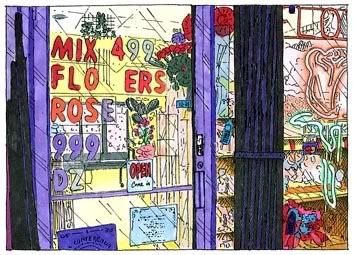
Flower shop on Clark

More is more. Here's another confused drawing of a confused storefront. This is your one-stop-shop for stuffed animals, mylar balloons, cut flowers, chess sets, phone cards, and plastic toys.


I love the lettering in the windows. Certain letters have peeled off and been replaced with different colors. The overall effect is nice, and may be intentional. Or maybe those were the only colors available.

This may be the last storefront on Clark that I post, although I want to stick with night images for a while.

Wednesday, September 20, 2006

Hair salon on Clark

I'm amazed at how many stores my neighborhood can support. And I can't claim there's enourmous variety, either. In the three block stretch of Clark between Greenleaf and Farwell there must be 8 taquerias, 4 bakeries, 10 dollar stores, and 4 hair salons. How do they differentiate themselves from each other? Not through design or signage. What makes one dollar store successful, while another closes within a month? I don't know. There are probably ties in my neighborhood that I never see.

But I realize that we've fallen into our own pattern of patronage. Is there any reason we go to Taqueria Uptown instead of the one two storefronts over? Is there any reason we always go to the corner store at the southwest corner of Lunt and Clark instead of the larger one just east of Clark? Maybe there's enough density in my neighborhood that it's able to support hundreds of these patterns and habits. Maybe that's what makes small businesses successful in the city. I have to admit- the ones that stick around are there for a good long time.

Wednesday, September 13, 2006

Busy week!


I'm still alive, although it's been a while since I've posted. Above is a detail from a larger image that I can't post just yet. I think it's an interesting study of street furniture. If I was really motivated I would have a separate notebook for stuff like this. 

I went back to The School of the Art Institute to give two brief lectures on neighborhood research. It was two sections of the same freshman studio, but it was fun. I don't kid myself into thinking that I do that sort of thing very well, but it was a great change of pace. And maybe I would get better if I did it more often. Or not. I found myself focusing on kids who were really interested and kids who were really bored.

I forgot about the crummy classrooms at the Champlain Building on Wabash and Monroe. Last night the odor of garlic permeated an entire floor. I assumed it was a performance art thing.

With 15 minutes until the 6:35 train I hopped on the Madison bus, got to Ogilvie in 10 minutes, had time to buy a ticket at the reduced price, and got a window seat with 2 minutes to spare. All while it was pouring rain. Who doesn't love public transit?

Monday, August 21, 2006

Our Ohio vacation, last one

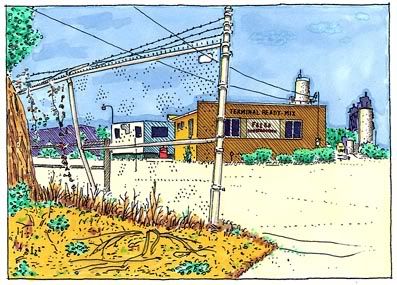
I asked Angela to take a few snapshots on our way out of Lorain, and this drawing is adapted from the best one. Although to be fair, it just barely edged out the Wonder Hostess Bakery Outlet further down the road.


Falbo Construction is one of the few remaining industrial businesses I remember from when I was a kid. I think they sponsored a baseball team, or a soccer team. Or maybe both. Much of the docks, mills, and plants along the Black River have since been abandoned or replaced with new development.

When I was a kid I used to risk death to jump on the slow moving trains down the embankment east of Broadway. Now most of the tracks have been pulled up and replaced with gazebos for river-front festivals. Maybe someday there'll even be a fast and easy commuter connection with Cleveland.

For 20 years Lorain has been trying to make the leap from depressed steel, ship, and auto manufacturing into a kind of recreational suburb for empty nesters and the boating set. But it feels forced to me. It feels counter to the character and history of the city. This was a tough city, where you could make a good living if you were willing to work hard. Maybe that's why I was glad to see Falbo Construction. Not pretty, but tough.

Friday, August 11, 2006

Our Ohio vacation, day 8, part 2


This is Angela (with Felix in his sling) and Mom walking towards the Ohio Edison Plant in Lorain. For some reason I'm always surprised to see this huge electrical plant looming on the lakefront. When I was a kid it was so much a part of the landscape that I never thought about it.


The plant would vent its waste water at a nearby pier, which we creatively called, "Hot Waters." In the winter all the fish would gather at Hot Waters, which would never freeze. The place would be alive with these huge carp and sheephead. We would engage in a particularly unsportsmanlike type of fishing known as "snagging". You didn't need any bait, just a big treble hook and a strong line.

If you think it's hard to remove a hook from a fish's mouth, try removing one from their spine. And these were junk fish. You couldn't even eat them. OK, it was a loathesome activity. Welcome to Ohio.

Tuesday, August 8, 2006

Our Ohio vacation, day 8

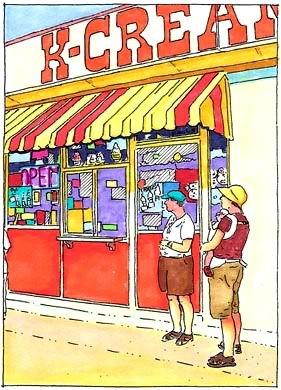
K-Cream Korner was one of the institutions that defined my summers from ages 8 to 12. Before becoming a take-out ice cream shop it had been a vacant gas station. Before that I suppose it was an occupied gas station... Anyway, the owners hung a loud orange sign and never looked back.


I walked past this place every day in junior high. It may even explain my astonishing number of cavities. They sold packaged sugar in so many forms- Lemonheads, Redhots, Boston Beans. Nice to know some things never change.

K-Cream Korner is just far enough from my parent's house that it seems like you can walk off the calories on the way back. In reality, you would probably need a few more miles. This is my mom and Angela waiting for their soft-serve to be ready.

Friday, August 4, 2006

Our Ohio vacation, day 6


One of the nicest things about visiting Ashtabula is having breakfast at Squire's Bakery. We had donuts and coffee here twice. The first time I had an apple fritter so huge that I couldn't finish it.

I also like their coffee. It comes in little disposable cups that snap into a plastic frame with a handle. For some reason it reminds me of lunchtime at camp.

And what a great building. Too bad it isn't a little closer to the historic (but depressed) Bridge Street District. It would result in a nice influx of badly needed foot traffic.