Showing posts with label Ohio. Show all posts

Thursday, August 3, 2017

Broadway and E. 20th Street, Lorain, OH

This strip of buildings is on Broadway in my hometown, Lorain, Ohio. These were constructed in the 1880s and 1890s, and although they've been altered they still retain distinctive features.   The  parapets of the red brick buidings are ornamented with elaborate corbelled brick, and the sills and lintels are a golden sandstone quarried from nearby Amherst, OH.


What especially caught my eye is the great mid-century slip-cover applied to a portion of the corner building.  These façade treatments were meant to update and revive old commercial buildings but they've become historic artifacts in their own right.

The design of these slipcovers had more in common with the graphic design popular in the 1950s and 60s, often with a nod to the high-style modernist towers going up. And because they weren't doing much structural work they could look like anything. A covered building could instantly transform from a pedestrian scale to an auto-oriented scale, and this was one way historic downtowns competed with the postwar suburban expansion.  It didn't really work, so now these architectural treatments are often reversed to reveal the original character of a building.

Clear aluminum mullions and turquoise spandrels were applied to the façade, along with new windows and storefronts. There was enough flexibility in the system to adapt it to the size and configuration of the original facade, although it wasn't unusual to have to chip off projecting masonry that interfered with the new system.   Finally, a wide band of stainless steel framed the entire composition.  I believe those three stubs above the storefront supported a large vertical sign which has since been removed.

This is a great example for its pure geometric design, but also because it serves as a clear visual lesson in how buildings change over time.
 
A few blocks north at Broadway and 16th Street.
Bars along 28th Street in South Lorain

Tuesday, August 2, 2016

Again, Lorain, OH

Broadway and E. 31st Street

Taking a bit of a break from my murder mystery to showcase a few random drawings of my hometown, Lorain, Ohio.
Broadway and E. 32nd Street
Broadway and W. 29th Street

Well, they're not exactly random. They represent an isolated historic commercial district that soldiers on, despite unrelenting adversity.  


These images were developed from reference photos taken during our Fourth of July visit.
(As a side note, happy 50th anniversary Mom and Dad!)


I like the strong shadows on this one, but it loses a bit of texture and intelligibility.

As always, Lorain is a textbook example of how historic buildings change over time, adapting to different needs and accommodating new styles.

Friday, January 8, 2016

Elyria Ave. and E. 28th St., Lorain, OH

L. Shure, 2016
Every now and then I need to post a drawing from my hometown, Lorain, Ohio.  This old diner may have been intended to serve the area when Czechs and Slovaks were arriving to work at the nearby steel plant and shipyards.

Because Lorain was such an industrial powerhouse, it drew workers from around the world, but especially from Eastern Europe.  I still remember visiting the nearby Polish American Club for their Friday Fish Fry.  I think that building has now become a social services agency.

With the closing of the mills and shipyards, many of Lorain's businesses are long gone. East 28th Street, which was once covered with bars and restaurants, was hit even harder than the downtown. But this remnant always catches my eye, with its hopeful modernist storefront looking a little more dilapidated each year.

Wednesday, August 6, 2014

Random Places in Lorain, OH

These images were developed from reference photos taken by my wife as we were visiting my hometown of Lorain, Ohio over the 4th of July.

It's strange to be a tourist where I grew up, but kind of nice, too.  It makes me realize how differently I look at the city.  Some of the patterns start to make sense, revealing things about a place which had once been so familiar that I never really saw it.

Tuesday, March 18, 2014

Hot Waters, Lorain, OH


When we were kids we had a limited wandering range, which was basically a half-mile from the house.  Within that half-mile there were certain activities we could do without supervision.  One of those was fishing with our plastic Zebco rods.  This was a thankless task, which sometimes resulted in catching large, inedible fish.  Hot Waters was the best place to do this. 

The waters were “hot” because of the effluent from the nearby Ohio Edison electrical plant, which loomed over the crumbling docks.   In the winter the place surged with fish attracted to the warmth.  We would sometimes go “snagging” which involved  ripping a large tripled barbed hook through a dense mass of fish.  It was not very sportsmanlike…
This is the little bait shop where we would buy minnows and worms. We would scoop our own minnows from a large aluminum tank, which was often the only fish I would catch.  Their real business was probably selling ice and beer to the boat owners who would launch from this area.

With the recent demolition of the electrical plant and the opening up of the lakefront I wonder how this area will be used now.

Thursday, January 31, 2013

Summer Cottages in Conneaut, OH

Once again I'm back in Ashtabula County, where my wife grew up.  One of the most interesting things about this area are the lakefront cottages constructed between 1910 and 1930.  Often you'll find these tiny houses grouped around informal streets or dirt lanes.  I'm guessing none of them have more than a couple rooms.  Many  look like they were ordered as a kit, or were prefabricated and lowered on to a foundation.  Basically these are summer campsites with buildings replacing the tents.  
Concrete block summer cottages in Conneaut, OH
As American leisure time began to increase in the 20th century new recreational options were developed. 
The wealthy could visit oceanside resorts or travel (or maybe buy horses?), but middle and working class families had fewer established vacation choices, especially in rural areas.  But what could be more attractive in northern Ohio than the cool shores of Lake Erie?   As demand increased more of these permanent camps were constructed.  Some attracted commercial development, resulting in roadside strips of restautants, stores, and miniature golf.  But how did these begin, and how did they develop over time?  How did these families spend their time, and how long did they stay? And how did these areas relate to the nearby traditional communities? If books or articles have been written about this I haven't yet found them.

Some are still used as seasonal rentals and some have been converted into affordable year-round residences.  Many appear abandoned.  These buildings are my new Ashtabula project, so if anyone has any leads to follow-up on our next Ohio trip please drop me a line.

Wednesday, July 25, 2012

Back to Ohio

Although I was born and raised in Lorain, Ohio I've been living in Chicago for the past 17 years.  Sometimes I feel like a tourist when I go back to visit family.  This isn't always a bad thing. It makes me reevaluate some of the things about Lorain that I've always taken for granted.  And somehow I've acquired another Ohio hometown-- Ashtabula, where my wife grew up and where we visit Felix and Theo's grandmother. This post is a visual record of our visit over the week of the Fourth of July.


This is an old Quonset Hut in Saybrook, OH, repurposed as a storage building.  I'm surprised how many storage buildings are found in rural areas.  Doesn't everyone have enough space?  Perhaps it's just an easy way to get some return on a large building without having to add many improvements.  Quonset huts were perfected during WWII-- easy to construct and easy to remove when no longer needed.  This one has been made permanent with a concrete "skirt" poured around the perimeter.


I believe this is an old Pure Oil Service Station which has been altered and covered with vinyl siding.  Angela tells me that it used to be a gun shop, but it looks like it's been vacant for some time.  I think this is also in Saybrook.


This is a concession stand from Geneva-on-the-Lake.  This the low budget 1920s resort strip that I've written about (and drawn) before, but it still fascinates me.  If we ever move back to northern Ohio I think it would make a good research project.


 To the left is a detail from the Bridge Street District in Ashtabula.  There's  a great collection of Italianate and Queen Anne style storefronts here,  remnants of a more prosperous time.  If there was any justice in Ashtabula this would be the most popular shopping district in the county.  You can almost feel it struggling to become the alternative to the strip malls that pass for commercial districts everywhere else.


I believe this is a grain depot in Austinburg, just down the road from our hotel.  I've never been sure of how these things work.  Somehow grains are lifted to the top of the apparatus and a separated into different grades in various containers.  They probably would be surprised if I asked for a tour.


 This is also in Austinburg.  Judging by the Greek Revival style I have to place this around 1850, if not earlier.  Due to a pesky fire in 1871 it's not possible to see buildings of this age in Chicago, although you can still find some in the suburban areas.  It looks vacant.  Even the trailer parked in front to sell overstock fireworks looks pretty run-down.


So finally we get back to Lorain, which made its reputation as a major steel city on Lake Erie.  The steel mills are still in South Lorain, but they're a shadow of what they once were.  This is a view from 28th Street.  I remember the mountains of purple iron ore that would be unloaded from enormous ships docked on the Black River.  Not as much of that anymore.


Here are some storefronts at Grove and E. 30th Street, not far from where my sister lives. They look vacant, but sometimes it's hard to tell.


And here's my last image of Lorain. A lone brick and frame cottage with bay windows. It looks like the storefront has been converted into a bar.  A very dark bar.  I'm not likely to walk into a dark bar, but maybe I'm not their target customer.

Monday, November 15, 2010

More Unremarkable Buildings in Lorain, OH

Moving on slightly from Ashtabula to Lorain, Ohio, land of my birth.

When we were kids there were well-defined areas we were comfortable exploring.  But the most exciting ones were on the edge of our range.  To the east was Dairy Queen, but to the west it was Chapman's. 
Chapman's Food Mart was cool.  There were entire aisles of junk food.  Kids were not particularly welcome, probably because of shoplifting.  You could buy one slice of bologna for 10 cents.  I'm pretty sure my older brother introduced me to it, as he did most of the questionable experiences of my childhood.  For some reason I'm glad to see that it's still there, and possibly still under the same ownership.

It's good to see Ardick's Seafood is still around.  Unless you've lived close to Lake Erie it will be hard for you to understand the importance of perch in maintaining mental health.  I can't really explain it.  You can buy fish here or you can have them fillet your catch.  Despite living in Lorain for 18 years I never once caught a single fish worth eating. I try not to be bitter about it.

For the life of me I can't remember what this diner was called when I was a kid.  My Dad used to bring us here on walks in the winter.  We would drink hot chocolate at the counter and play their tabletop video game.  It was Popeye, which was state-of-the-art at the time.  Only now do I realize that these long winter walks were probably designed to give Mom a break from the three of us.  Probably four of us, including Dad.

Tuesday, November 9, 2010

Geneva-on-the-Lake, OH

Back to Ohio!  Maybe 2 more entries before I return to Chicago.

One of the more enjoyable destinations when visiting Ashtabula is a drive west to Geneva-on-the-Lake, which is basically an old cruising strip and linear carnival.  And if you're wondering where all the biker bars are in northeast Ohio, look no further.

This is the type of summer resort town that you might find on the east coast, not on Lake Erie.  There are wine gardens, putt-putt golf courses, arcades, water slides, hamburger joints and bars.  Lots of bars.  This is where local folks come to relax, especially those that can't afford an expensive vacation.  Given the current economy, I wouldn't be surprised if Geneva-on-the-Lake received a big bump in visitors. 

In addition to the strip, there are tiny cottages and bungalows that people can rent for extended stays. According to my wife, most of these were strictly seasonal (meaning uninsulated) until recently.  Unlike an amusement park, this is a real place, and must be a lot of fun late at night.

The buildings are worth a study in themselves.  Many of these look temporary, but must have been in place for 50 years or more.  Above are two connected Quonset huts.  These were a popular and cheap way of creating space after WWII.  Some of the buildings look like old frame houses converted to commercial uses, but others look like elaborate hot dog stands that just kept growing.

I can't help but wonder how a town like this develops.  There doesn't seem to be any rhyme or reason, but somehow it works.  Other, more modern developments have located on the edges of the district, but they're too far to impact the character of the area.  I have to wonder when the tipping point is reached- when there are too many cars and people to be absorbed into the network of spaces.  But I've been there maybe half a dozen times, and have yet to see it overwhelmed.  And sure, they don't have enormous roller-coasters, but no one is charging you $45 just to walk around.  And $45 can sure buy a lot of insanely sweet Ohio wine.

Friday, October 29, 2010

Ashtabula Harbour Commercial District, Ashtabula, OH

Getting away from Chicago for a bit, I'd like to talk about Ohio, where I grew up. More specifically Ashtabula, Ohio, where my wife grew up. 


There are a surprising number of similarities between Ashtabula and my hometown, Lorain.  Both pretty much exist because of their location at the intersection of Lake Erie and a major river. Just like the Black River in Lorain, the Ashtabula River created a natural harbor (which was then enhanced through dredging).  In the 1950s the expanding chemical industry made the Ashtabula harbor one of the most important on the Great Lakes.  And also one of the most polluted. 


Ashtabula Harbour Commercial District
Before the area sunk into depression (along with the rest of Ohio), some remarkable commercial districts were built.  One of the best is the Ashtabula Harbour Commercial District, which has been on the National Register since 1975.  This was apparently a concentration of saloons and houses of prostitution back at the turn of the century.  It's become a bit more sedate since then. 


Ashtabula Lift Bridge- View looking east


The Ashtabula Lift Bridge was completed in 1925.  It's always an odd thrill to drive under the 420 ton concrete counter-weight hanging above the roadway.  You can tell a bridge intended for purely functional needs- it doesn't much care about blocking the views up and down the river.  This is in contrast to the bridges on the Chicago River, where a great deal of engineering went into minimizing the visible support structures. But to be fair, there's not much height above the water to work with here. The bridge acts as a gateway into the historic distirct to the west.


Goodwill Buildings
This is the Goodwill complex a block south of Bridge Street.  It's really a collection of buildings strung together, probably from the 1960s.  Not a particularly graceful combination, but since these are the newest construction near Bridge Street it gives a good sense of the needs of the community.  I've never visited Ashtabula without making a stop at this Goodwill, and it's always busy.  While maybe not an engine of economic development, it does attract people to the area.


Italianate Commercial Buildings


The core of the district is an impressive block of 2-story brick buildings between Hulbert and Morton.  The frame buildings shown above are just to the west.  It's rare it is to find historic commercial frame buildings like this in decent condition. It looks like someone has been taking care of these, even to the point of a partial restoration.


I think this area has an incredible amount of potential.  It's already attracted a number of unique businesses and restaurants.  And because it's on the National Register it's qualified for tax credit projects.  I think Ashtabula knows what it has here, but maybe could be more active in attracting investment.  After all, there aren't that many alternatives to strip malls left in the area...


Tuesday, February 16, 2010

Lorain Sketches

Two or three times a year we drive for 7 hours to visit my parents in my hometown, Lorain, Ohio. I was born in Lorain and lived there until I graduated from college.  I have a lot of fond memories of the place, but it's been a depressed town for decades.
When I'm visiting I'm drawn to buildings that look depressed.  I'm not sure why.  There are plenty of very nice, non-vacant buildings in Lorain.  OK, not an enormous amount of them, but enough. 

Colorado Avenue is a good street to spot vacant buildings.  Some look like they used to accomodate light industry and some look like retail stores fallen on hard times.
Above is the American Legion Post on West Erie Avenue.  This is a complex that's actually grown over the years.  But it doesn't exactly radiate a feeling of prosperity.
This is the old Dairy Queen on East Erie Avenue, now Terry's Dairy.  They didn't bother to remove the old Dairy Queen signage framework. I'm not sure if this is out of business or just closed down for winter.  It looks out of business. DQ used to represent the end-point of our longest family walks in the summer.
And of course, watching over the lakefront is the old Ohio Edison Plant.

I often wonder what my life would be like if I still lived in Lorain.  Someone once told me that no matter where you go you'll only have roots in the place where you were raised.  But can roots outweight a depressed economy and a struggling government?

But I have to admit, I've had a strange Lorain daydream lately.  I dreamed that everyone who left to pursue college degrees, or careers, or families suddenly decided to return.  All of the empty houses suddenly had buyers.  The hardware stores sold-out of ladders and paint.  The doctors and lawyers renovated the vacant storefronts downtown.  An influx of thousands of kids required schools to be repaired and reopened.  It could happen.  Or if it can't, why not?

Monday, August 21, 2006

Our Ohio vacation, last one

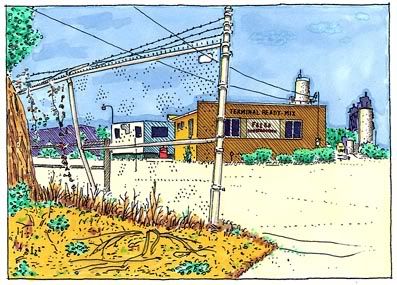
I asked Angela to take a few snapshots on our way out of Lorain, and this drawing is adapted from the best one. Although to be fair, it just barely edged out the Wonder Hostess Bakery Outlet further down the road.


Falbo Construction is one of the few remaining industrial businesses I remember from when I was a kid. I think they sponsored a baseball team, or a soccer team. Or maybe both. Much of the docks, mills, and plants along the Black River have since been abandoned or replaced with new development.

When I was a kid I used to risk death to jump on the slow moving trains down the embankment east of Broadway. Now most of the tracks have been pulled up and replaced with gazebos for river-front festivals. Maybe someday there'll even be a fast and easy commuter connection with Cleveland.

For 20 years Lorain has been trying to make the leap from depressed steel, ship, and auto manufacturing into a kind of recreational suburb for empty nesters and the boating set. But it feels forced to me. It feels counter to the character and history of the city. This was a tough city, where you could make a good living if you were willing to work hard. Maybe that's why I was glad to see Falbo Construction. Not pretty, but tough.

Friday, August 11, 2006

Our Ohio vacation, day 8, part 2


This is Angela (with Felix in his sling) and Mom walking towards the Ohio Edison Plant in Lorain. For some reason I'm always surprised to see this huge electrical plant looming on the lakefront. When I was a kid it was so much a part of the landscape that I never thought about it.


The plant would vent its waste water at a nearby pier, which we creatively called, "Hot Waters." In the winter all the fish would gather at Hot Waters, which would never freeze. The place would be alive with these huge carp and sheephead. We would engage in a particularly unsportsmanlike type of fishing known as "snagging". You didn't need any bait, just a big treble hook and a strong line.

If you think it's hard to remove a hook from a fish's mouth, try removing one from their spine. And these were junk fish. You couldn't even eat them. OK, it was a loathesome activity. Welcome to Ohio.

Tuesday, August 8, 2006

Our Ohio vacation, day 8

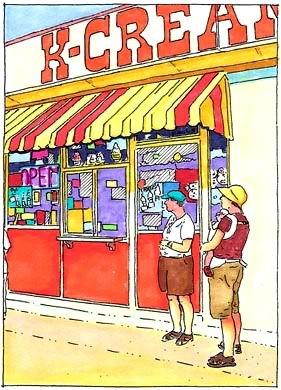
K-Cream Korner was one of the institutions that defined my summers from ages 8 to 12. Before becoming a take-out ice cream shop it had been a vacant gas station. Before that I suppose it was an occupied gas station... Anyway, the owners hung a loud orange sign and never looked back.


I walked past this place every day in junior high. It may even explain my astonishing number of cavities. They sold packaged sugar in so many forms- Lemonheads, Redhots, Boston Beans. Nice to know some things never change.

K-Cream Korner is just far enough from my parent's house that it seems like you can walk off the calories on the way back. In reality, you would probably need a few more miles. This is my mom and Angela waiting for their soft-serve to be ready.

Friday, August 4, 2006

Our Ohio vacation, day 6


One of the nicest things about visiting Ashtabula is having breakfast at Squire's Bakery. We had donuts and coffee here twice. The first time I had an apple fritter so huge that I couldn't finish it.

I also like their coffee. It comes in little disposable cups that snap into a plastic frame with a handle. For some reason it reminds me of lunchtime at camp.

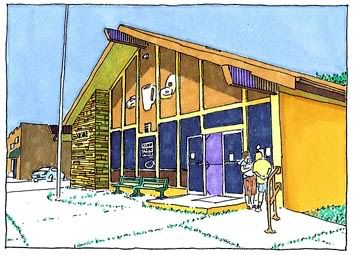
And what a great building. Too bad it isn't a little closer to the historic (but depressed) Bridge Street District. It would result in a nice influx of badly needed foot traffic.