(An earlier version of this article was published on the site in 2015.)
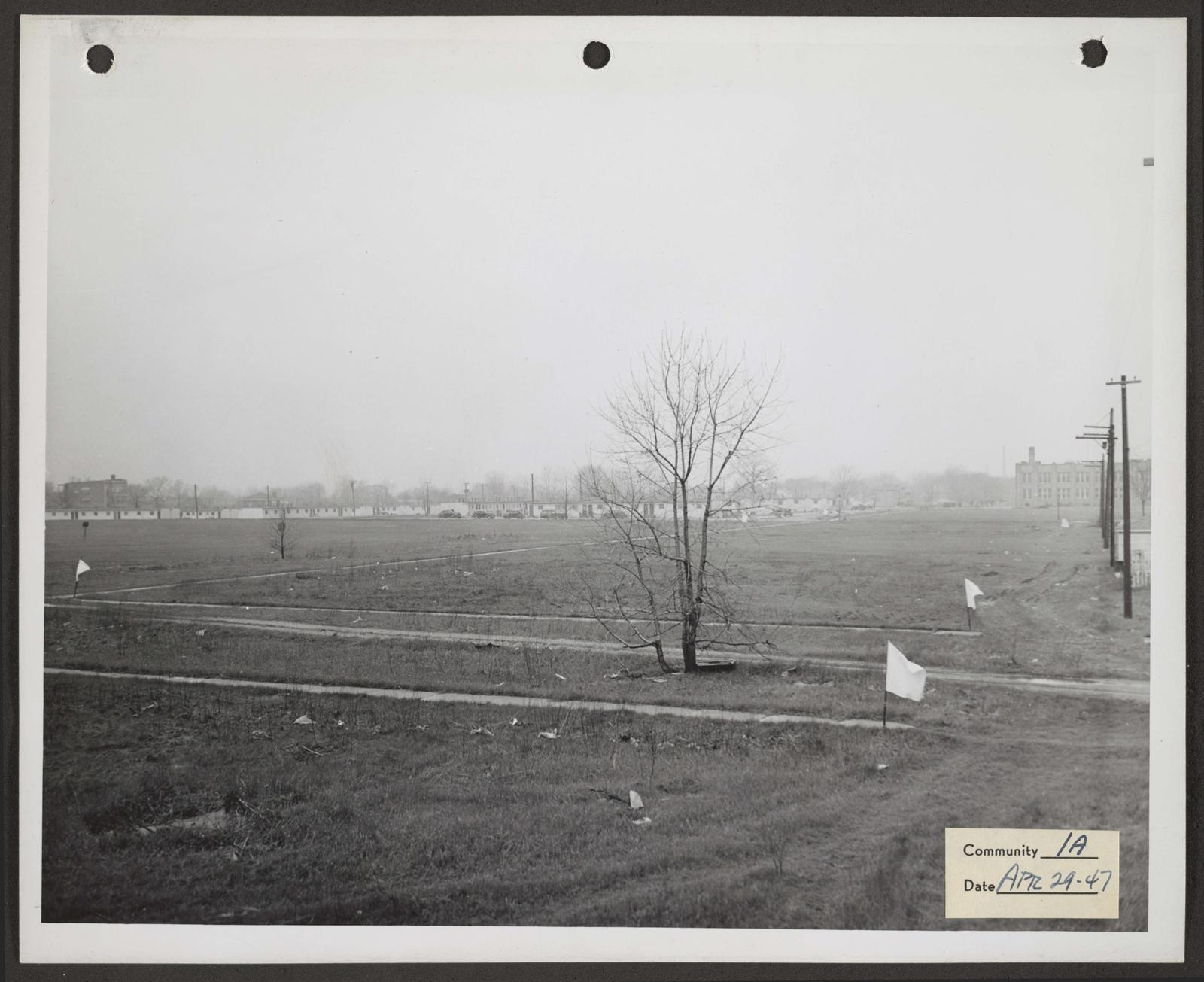
When WWII veterans returned home, they faced a severe housing shortage. One government remedy was to repurpose housing built for war workers into inexpensive rentals for returning soldiers and their families. Areas identified for temporary housing were typically government-owned and sparsely developed. And this is how a series of pre-fab homes ended up in an undeveloped park in West Ridge.
 |
Current Aerial image of Rogers Park showing the
location of the temporary veterans housing in red. |
During WWII, the demand for housing to support the war effort jump-started the prefabrication industry, which had long promised mass-produced, inexpensive homes. Wartime contracts sometimes resulted in cities appearing practically overnight. A memorable example is Oak Ridge, Tennessee, where 75,000 people were housed and employed to process the uranium needed for the Manhattan Project. At the end of the war, these homes (and similar ones across the country) were considered surplus and made available as emergency housing for returning veterans. Residential structures from Oak Ridge actually ended up in Chicago's Hanson Park area.
In the West Ridge neighborhood, the Chicago Board of Education (which built the nearby Rogers School in 1936) leased a 10-acre plot to the Chicago Housing Authority, which received City of Chicago funding to prepare the site and install utilities. But it was not clear sailing. Mayor Edward Kelley sought greater Federal reimbursements, freezing the program in the summer of 1946 until he was satisfied that the Federal Government would provide additional financial support.
Although the area was sparsely developed, nearby residents were not pleased. They didn't see temporary housing as a good way to increase property values, and they knew the area would soon attract private development. They petitioned CHA to choose another site but were reassured that all temporary housing for veterans would be demolished within three years. The project moved forward.
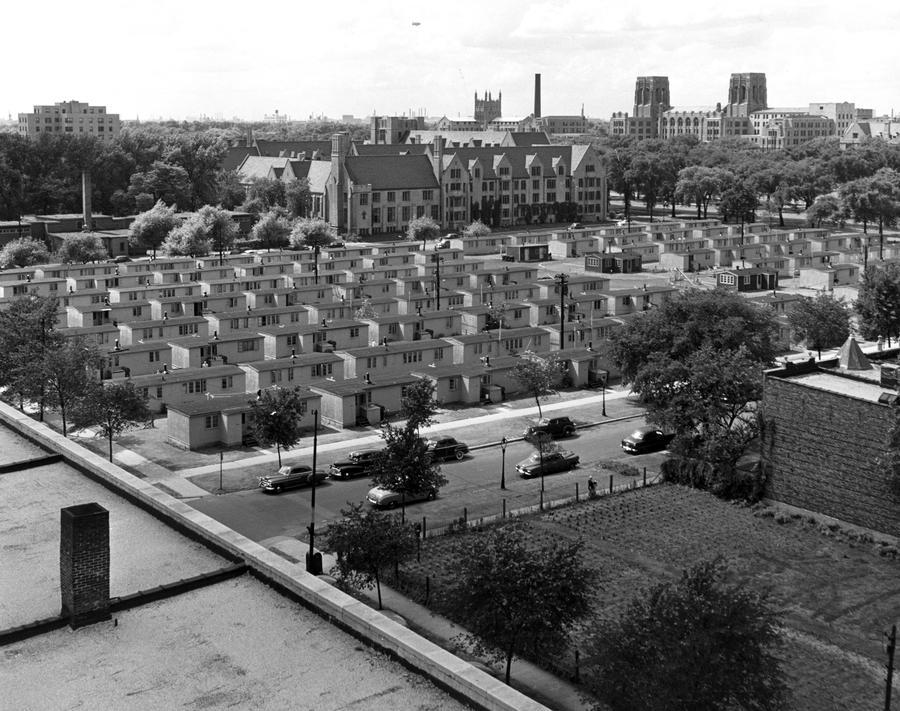
Soon, twenty panelized buildings relocated from Seneca, Illinois, and Evansville, Indiana stood on the formerly vacant land south of Rogers School. Twenty-five feet wide and 116 feet long, each one-story barrack-like structure accommodated six families. To allow the installation of demountable residences, Kelly's City Council had also waived the Chicago Building and Fire Codes.
The temporary housing program also had a racial component. Of the returning veterans, 20% were black. Previously, CHA based its racial policy on the Neighborhood Composition Rule, which meant that public housing observed the predominant racial makeup of the surrounding area. In 1946, this was changed to support a policy of integration. Several of the integrated developments attracted anger and violence from surrounding white residents, including those near Midway Airport, Fernwood Park, and Edison Park. It's unclear whether the Washtenaw-Sherwin Homes were integrated, but it seems unlikely. A change in leadership from Mayor Kelly to the less racially progressive Martin Kennelly likely also affected the CHA policy. In the end, approximately half of the temporary veterans' housing projects were integrated.
In 1947, the Chicago Park District took the opportunity to acquire some of the surrounding land, and by 1950 a new 20-acre park had been established to the east.
Despite CHA's promises, the trailers weren't removed until 1953. By then, the homes had far outlived their design life, and many seemed unlikely to survive another Chicago winter. CHA moved remaining eligible families to permanent housing, and staff helped others find units in private developments. The underlying 10 acres were then absorbed into an expanded Rogers Park.
Collective memory of the temporary homes seemed to quickly fade. In 1957, the Chicago Park District awarded a contract to further develop the park. A Tribune article noted that the property had been used as a golf driving range, truck gardens, and a site for greenhouses. But it doesn't mention buildings that housed 120 veterans and their families for seven years.
Of the twenty-three sites used for temporary veterans' housing in Chicago, very little evidence remains. But while I was putting together the map for this post, I realized the large linden trees in the park sit between the north and south halves of the development, and perhaps they were planted to give the veterans and their families a sense of beauty and stability. So maybe that's a small nod to history for those who know to look for it.
 |
| Map of Eighteen Remaining Temporary Housing Projects in 1951. Five trailer projects had already been demolished. Most sites were on the city's periphery. (Data from "Favor Razing of Temporary Vets Housing" noted below, with some intersections corrected/updated.) |
Selected Sources
"Kelly Predicts U.S. Will Pay Funds for Veterans' Homes," Chicago Tribune, June 18, 1946, 3.
"City to Speed Opening of 724 Homes for Vets," Chicago Tribune, June 27, 1946, 9. https://www.newspapers.com/image/372476724/
"Favor Razing of Temporary Vets Housing," Chicago Tribune, October 18, 1951, 45. https://www.newspapers.com/image/370098790/
"Pontiac Homes, A Jalopy of a Village, Junked," Chicago Tribune, November 2, 1952, 197.
"Rogers Park Contract Let for $246,177," Chicago Tribune, September 1, 1957, 85.